There is one pond parameter that many fish pond owners may not be aware of or know the extreme importance. That one is KH. It is the one that impacts ammonia, nitrite, nitrate, fish health and pond stability. It stabilizes your alkalinity or base values (pH) and basically, if you have sufficient amounts in the pond, you do not need any other tests. In essence, it is responsible for the nitrification process in the koi pond: conversion of ammonia à nitrite à nitrate. No, you really do not need to be a scientist to qualify as a pond owner. You will need this test kit—KH (Carbonate Alkalinity)—and you will need to be diligent with testing. Or you will have to know the signs and respond quickly.
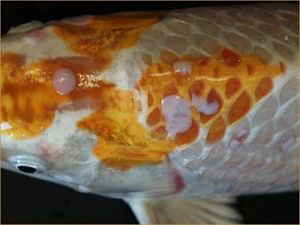
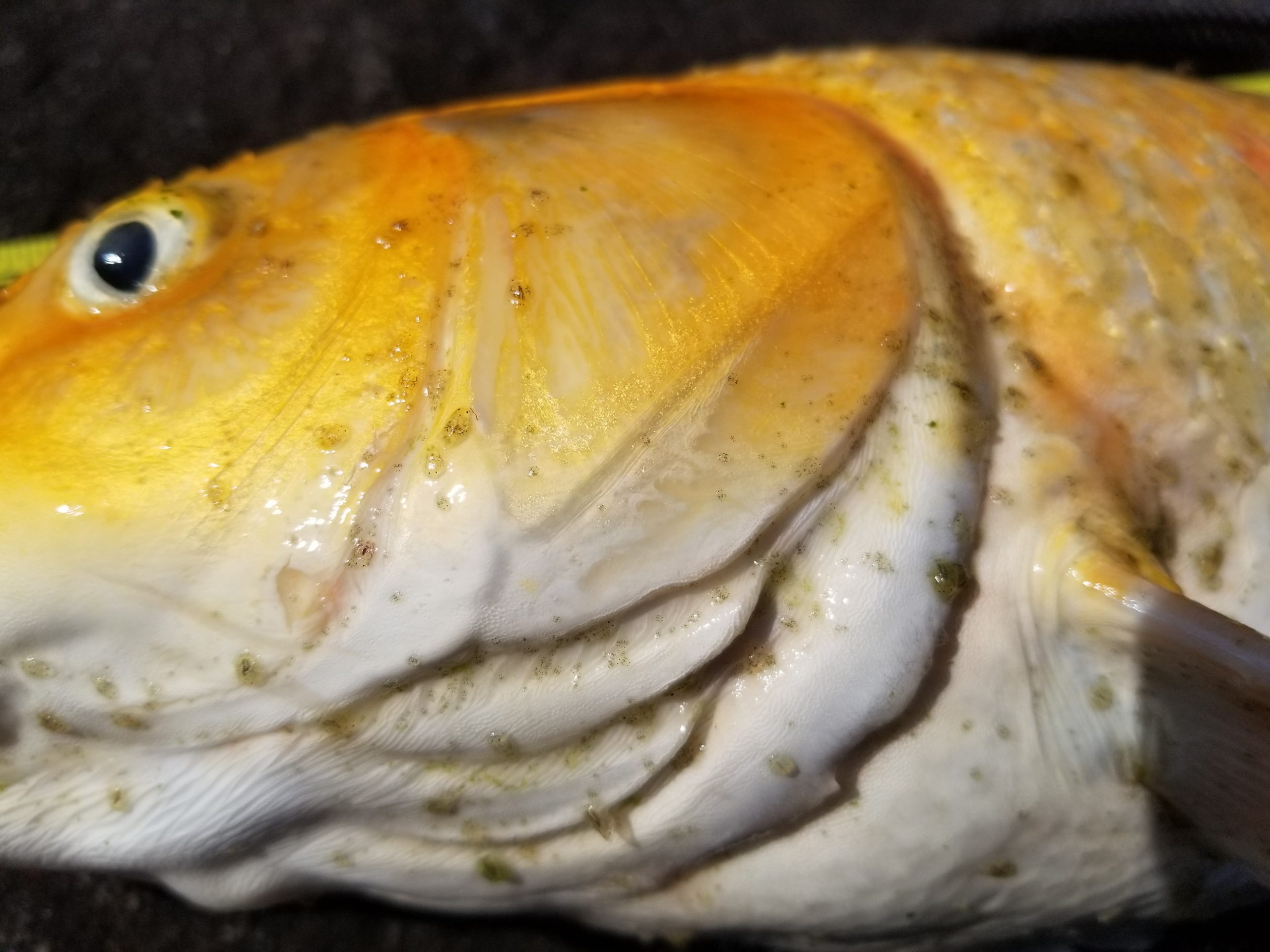
Over the years, I have received many calls from frantic owners whose fish were dying because their KH dropped. Many others have treated their fish with a (toxic) chemical “soup” because owners didn’t know what was killing their fish. They thought it must be parasites. Parasites are the first thing we think when fish flash, jump, lay on the bottom listless, stop eating, stop swimming around, etc. But when we test the pond and find our “ammonia has spiked” we toss in chemicals to lower ammonia. The ammonia may have spiked because your nitrification cycle isn’t working. That’s when fish begin to lose appetite, gills redden, they hover at the bottom of the pond and some may show bleeding gills toward the final stages before death. A lot of people reach for something to lower pH instead of ammonia, trying to reduce toxicity. It is horrible to stand helpless and watch your fish die.
Back in the 1990’s, we blamed the fish deaths on Aeromonas and Pseudomonas (on Long Island, NY) because we had no idea about KH.
I have seen Nitrites show up in a mature pond when the nitrification cycle stops. I would expect this in a new pond, just beginning to cycle, but not in a mature pond. Fish may gasp at the surface. This is when many owners reach for a broad-spectrum chemical treatment, thinking it has to be parasites in the gills. Well, it is trouble with the gills, but it may not be a parasite. Adding salt, 1 teaspoon per 300 gallons of water, can help at that moment, but it’s only a temporary fix. And you don’t want to add salt when using broad spectrum treatment.
Let’s look at what KH is and what it does in your pond. KH is the “usable” part of your alkalinity. Your nitrifying bacteria (Nitrosomonas and Nitrobacter) need 7.1 mg of KH to convert 1 mg of ammonia to nitrites and then to nitrates. A heavily stocked pond will use more KH during the course of a day. Likewise, a dirty pond will also use more KH than a clean pond as bacteria process the organic matter. The more ammonia being produced, the more KH is necessary to even start the process.
Now, as the KH is used during nitrification, remember that it is also necessary to stabilize the pH. Without it, your pH will also begin to drop. This could result in a pH crash. When the pH drops suddenly, goes below 6.5, it is called a “pond crash” and everything in the pond may die.
An interesting side note about KH is that being alkaline (Carbonate Alkalinity), it is notably not lacking in concrete ponds. I would say that if you paint your concrete pond or coat it in some way to prevent the concrete from being accessible, it would then become very much like a lined pond. How do you renew the depleted KH? First, test your tap water! If your tap has sufficient KH then a simple partial water change can replace the KH as you need it to keep everything running smoothly.
Since poor nutrition, parasites, bacteria and virus can all show similar symptoms as listed in this article, we can’t rule them out. However, it is worth a couple of minutes to rule out low KH as the problem before treating the fish for anything else. The pond must have a minimum of 100 ppm at all times. Many experts recommend keeping a 150-175ppm level.
…………………………………………………………………………………………………………………………………………………….
QUESTION: Now, why does a season of flooding rains seem to create problems that include algae blooms and KH depletion?
ANSWER: What we have here is a predominance of acid rain that will not only lower the alkalinity of the ground water, it will quickly lower the alkalinity in your pond. Without proper nitrification and denitrification, your pond is left with abundant nutrient content, including the initial ammonia from the fish. Algae is equipped to utilize ammonia directly from the water without waiting for nitrates (end process of nitrification) and phosphates. Since your KH will be lowered, the nitrification will then diminish, giving rise to ammonia in the pond. And algae.
QUESTION: What if my ground water has naturally low pH or has no KH?
ANSWER: You can’t count on partial water exchanges to replenish lost KH. Other sources commonly used are Arm & Hammer Baking Soda, Microbe-Lift/KH Bio-Active Booster, and crushed coral or crushed oyster shell (but it must be crushed).
QUESTION: Why would we use the Microbe-Lift/KH Bio-Active Booster instead of Baking Soda?
ANSWER: I recommend using either in an emergency but Microbe-Lift/KH Bio-Active Booster has directions for one thing, and is longer lasting in the pond than Baking Soda. It can give you more time to get the crushed coral or oyster shell as a more permanent solution. Or, if you choose, you can continue using the KH Booster now that you understand the importance of KH to your fish.
BONUS QUESTION: How long does a KH test kit last?
ANSWER: As with any other test, when the expiration date has been reached, replace it. It is no longer accurate.