By Carolyn Weise, Printed in Pond Trade Magazine
There are bugs and then there are bugs when it comes to what is wrong with our koi. Today we are going to forget about the familiar Ich that every hobbyist thinks of first when their fish starts flashing. We can forget about the internal cestodes, like internal flukes and tapeworms, the ones that require Praziquantel to treat. Today we will focus on the external, visible-to-the-naked-eye, crustacean-type of bug and a few others that are often overlooked. The big focus will be two crustaceans, both capable of killing fish right under our noses. I am talking about the Argulus (fish lice) and the Lernea (Anchorworm).
I had never experienced Argulus or Lernea in a goldfish bowl as a child. Neither did I see these crustaceans in my aquarium when I was a teenager. To me, crustaceans are ocean crabs, lobsters, crayfish, krill, and etcetera.
It wasn’t until I started keeping koi in the early 1990’s that a whole new world of surprises opened up. I learned how to use a microscope and do intraperitoneal injections without hitting any vital organs on my fish. A whole new world of knowledge was opening before me- veterinary care of my own fish, after KHV showed up.
One day I was taking a close look at my pond and found a few leeches. I didn’t think leeches were “good.” According to pondinformer.com, “Plant leeches and predatory leeches are not harmful to pond fish, and not all blood sucking species are actually capable of using fish as their hosts.” That is good news, but I kept reading: “… there is one species of leech to watch out for if you have goldfish and koi, and that is the fish leech (piscicola geometra). These long worm-like leeches are capable of attaching themselves to fish and sucking blood from their host, which can lead to dangerous infections and stress. The adult leeches are around 2.5 cm long, and often arrive to the pond attached to fish or inside pond plants. They’re difficult to catch as they can attach themselves to any part of the fish to feed, and often like to hide away within the gills and under the fins. The leeches, although unpleasant for the fish, are not deadly by themselves. The problem is the open wounds they leave which can lead to nasty infections, both viral and bacterial. In terms of a leeches’ life cycle, this varies depending on the species, but the most common fish leech, piscicola geometra, has a 30-day life cycle. This relatively short cycle can be used to our advantage to help starve the leech and prevent the eggs from hatching and finding a meal – hence a quarantine period is very effective.” There are leech traps, chemical agents to clean the pond, and perhaps better filtration, but the best key to “no leeches” is always prevention.
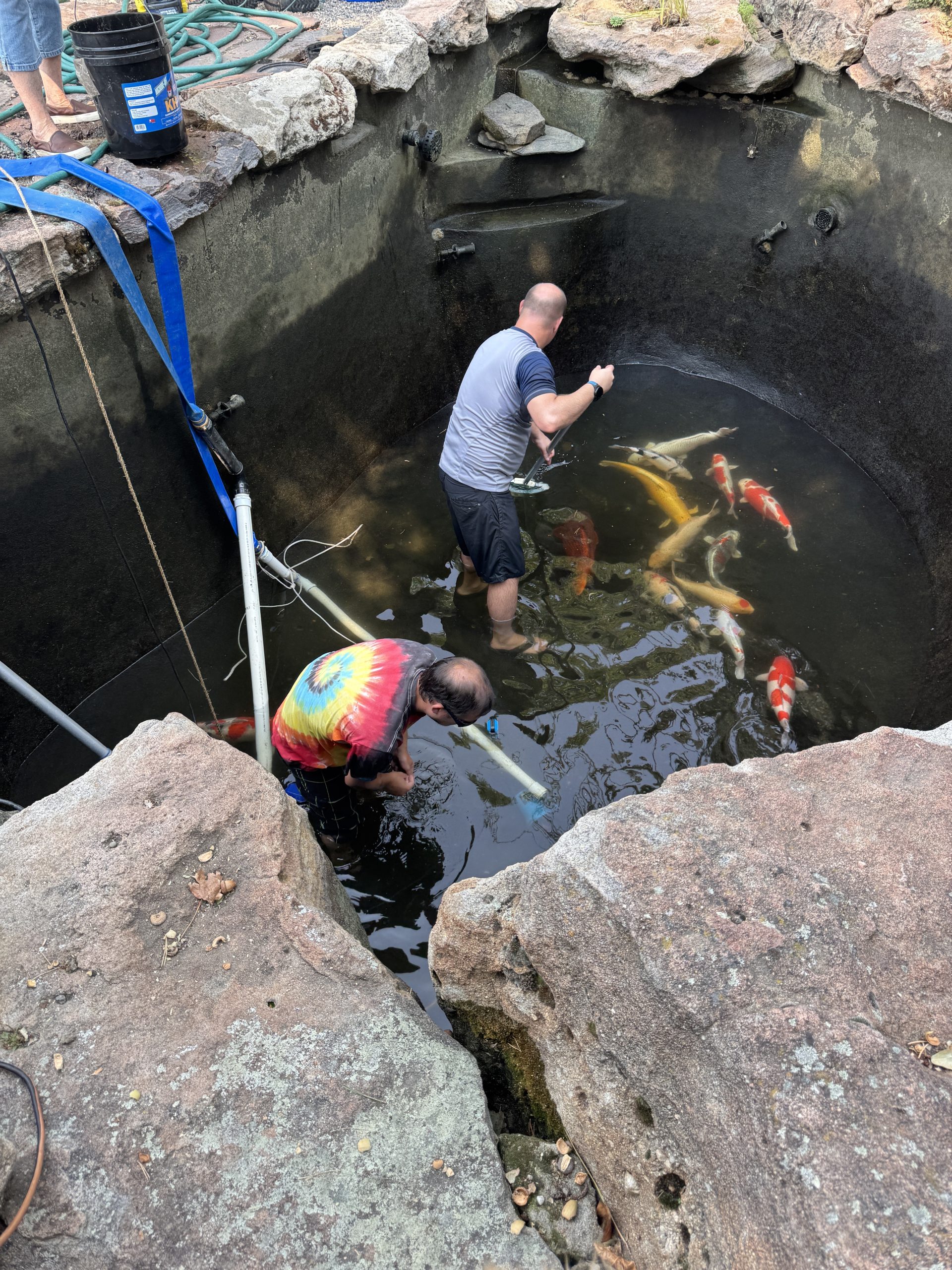
In fact, they were there because of detritus buildup. It was time to clean the pond. Pondinformer.com recommends, #1: Clean up the sludge/muck in the bottom! But there is even more! I found small red worms in the filter. There were lots and lots and lots of these. My stomach did flips, until I learned they were nothing but the Aquatic Midge larvae and the same type of bloodworm I used to feed my tropical fish (tubifex). A new filter pad would help, too. And, using Bti in the pond would get rid of the Aquatic Midge larvae, mosquito larvae, and black fly larvae. At four or five years into the hobby, I thought I was a conditioned hobbyist.
(NOTE: Microbe-Lift recommends ML/PL to have a cleaner pond and ML/BMC contains the Bti necessary to remove the Aquatic Midge, mosquito and black fly larvae.)
When Ecological Laboratories began manufacturing Lice and Anchorworm treatment, I started researching these parasites. I dug into their life cycles, affects of temperature on each, and how eggs will remain at the bottom over the winter months. I needed to know everything about them. I learned that Anchorworms are the ones that look like small pieces of white threads hanging from the fish with their heads firmly embedded into the skin beneath the scales. That should be easy enough to see when purchasing a new fish. And, the Fish Lice are nearly translucent, but if you look carefully, they are quite visible, greenish or grayish depending upon the fish (color) they are on, disc shaped, and have two “eyes” on them. They tend to mass together in one or more areas of the fish, like the tail, gill area, or dorsal. Where they bite into the fish, they leave an opportunity for Aeromonas or fungal infection to enter. Actually, both Lice and Anchorworm open the fish to infection where both are capable of killing the fish. Yet, I had not seen or experienced either of them personally, yet.
From the Tropical Aquaculture Laboratory, I learned that different life stages of Lernea during development live on and off the fish. After Anchorworms complete mating, the male dies and then the female bores into the fish’s tissue, using a large anchor on her anterior “head” end to permanently secure into the skin and muscle of the fish. The female matures into an adult and, within 24 hours, may begin to release eggs. Each egg hatches within 24-36 hours and females are very prolific. They can produce batches of up to 250 juveniles every two weeks for up to 16-weeks at water temperatures warmer than 77°F.
Lernea (Anchorworm) contamination in a pond can be caused by birds eating infected fish and then infecting another pond with its feces. Thus, causing the larval Anchorworm cycle to begin again. It can also be introduced by an infected fish, so it is important to carefully examine any new fish before they are released into your pond. Anchorworm can spiral out of control in a pond at an alarming rate. If left unchecked, the worm itself can cause major damage to the fish and potentially spawn deadly infections.
While Lernea is extremely damaging if not caught in time, the parasite can also be removed through the use of Potassium Permanganate. When used as a dip, the Anchorworm will release its hold from the side or back of the fish and can be gently swept away.
There are some notable differences from Anchorworm and Argulus (Fish Lice) although both are lethal to the pond fish. The Argulus life cycle averages 30-60 days, depending upon the Argulus species (yes, there are more than one) and the water temperature. All life stages of both sexes are parasitic. Argulus japonicus eggs hatch in 10 days at 95°F, but require 61 days at 59°F. Argulus foliaceus hatches in 17 days at 73°F, but at 68°F they hatch in 30 days. If laid in the fall, the eggs will survive over the winter until the following spring. In many species, the larvae must find a host within 2-3 days of hatching or they will die. Therefore, a crowded pond is a giveaway for the hatchlings. Once attached to the fish host, juveniles undergo a series of molts (11 molts or 12 “stages” in Argulus foliaceus) until they reach sexual maturity in approximately 30-40 days after hatching.
Fish without visible lice may show non-specific signs of infestation. These symptoms include: red spot or pinpoint hemorrhages, anemia, fin and scale loss, increased mucus production, lethargy, erratic swimming, reduced feeding, hanging at the surface (avoids swimming into the water column) and poor body condition. Fish may flash (rub against surfaces) in an attempt to relieve irritation or to remove the parasites. In some cases, there may be no obvious drug choice or length of treatment; Argulus infections should take into consideration the life cycle of the parasite, which varies from 30-60 days, depending on temperature and species, if known.
Koi Fish Lice “Argulus” is a crustacean, or “branchiurian,” parasite most commonly found in koi ponds, but are occasionally found in an aquarium. In an aquarium, the eggs are found in tubular structures on the glass and ornaments. In a pond, they are impossible to find.
Treatment must target all life stages, including eggs, juveniles, and adults, both on the fish and in the environment. Adult parasites can be manually removed from the affected fish, but this is impractical in many situations and is an incomplete solution because eggs, unattached juveniles and adults will still be present in the environment.
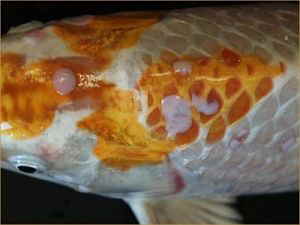
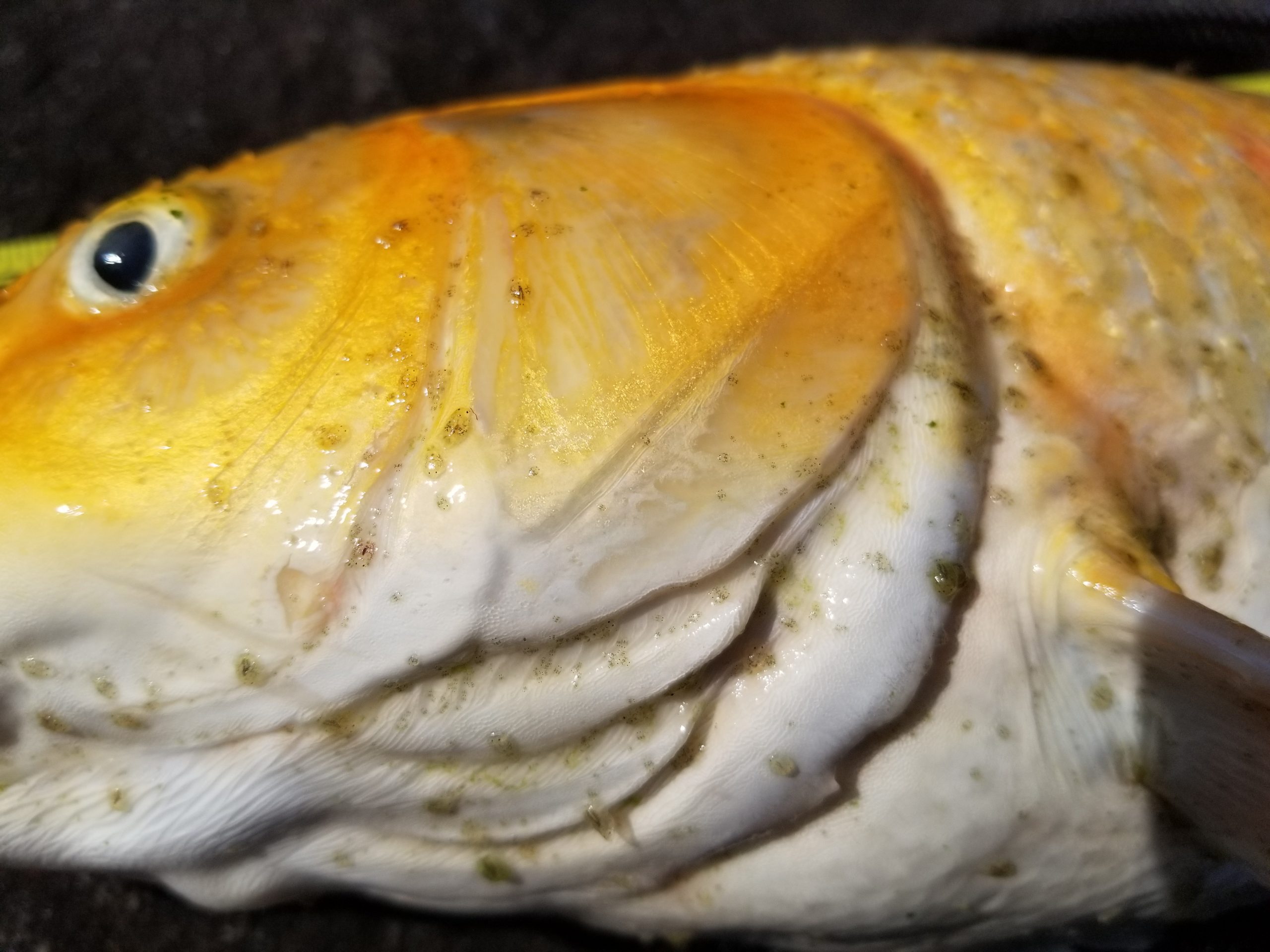
My actual introduction to Fish Lice came when a customer called for help. His fish were dying. After asking questions and ruling out the most likely causes for fish deaths in a mature pond, I learned he had added several new fish about a year ago. He did not quarantine, as many hobbyists choose, due to space restrictions. Naturally, he saved the dead fish to show me. I told him “Dead fish tell no tales…” But, in his case, they told the whole story. He insisted on sending me the photos of his dead fish. He could see nothing wrong with them. Reluctantly I viewed the pictures. In the first picture I noticed nothing. Perhaps this was because I was expecting nothing from them. But the second picture was a close-up and it was a remarkable shot of what happened to his fish. I have his permission to use the pictures in this article, so you will see what I saw. On one hand I could understand how an uneducated eye did not recognize the problem. And yet, to me, it seemed so obvious. I could feel the pain and suffering the poor fish had undergone. He had to treat his pond with Cyromazine, an insect growth regulator, also used by veterinarians for fleas and ticks on pets, which has proven quite successful in preventing the completion of molt which these parasites have to go through continually throughout their life cycle. He will also manually remove the adults from his fish for a better outcome. This is an important lesson for everyone when fish begin to die.
Sometimes you don’t need a microscope to identify the problem.